
Dealership Stock Transfers Without Delays
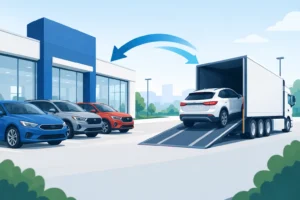
A sold vehicle sitting on the wrong forecourt costs time, space and customer confidence. Dealership stock transfers need to be organised around the handover date, the vehicle’s condition and the reality of dealer operations – not vague collection windows or a driver who cannot handle a non-runner.
Whether you are moving one retail car between branches, clearing part-exchanges, returning finance stock or repositioning vehicles across the country, the transport arrangement needs to protect the asset and keep your sales team informed. A properly equipped flat-bed lorry, insured carriage and clear vehicle reporting make a real difference when deadlines are tight.
Why dealership stock transfers need proper planning
Moving dealership vehicles is rarely just a case of collecting a car and dropping it somewhere else. The vehicle may need to arrive before a customer appointment, a workshop booking or a vehicle preparation slot. It may have trade plates removed, a flat battery, tyre damage, missing keys or a warning light that makes driving it on the road the wrong option.
A professional transport service removes those pressures from your team. Instead of asking a salesperson or site driver to spend half a day travelling, you can arrange a door-to-door collection and delivery that works around the branch’s opening hours and your customer commitments.
This also matters when a car is not roadworthy. Accident-damaged vehicles, non-runners, rolling shells and vehicles with mechanical faults should not be treated as ordinary drive-away jobs. A flat-bed recovery lorry with an onboard winch can load difficult vehicles safely, avoiding unnecessary mileage, further damage and arguments over who is responsible.
The right transport method depends on the vehicle
For many dealer groups, driven delivery may look like the cheaper option. It can be suitable for a straightforward, insured and roadworthy vehicle travelling a sensible distance. But it adds mileage, exposes the vehicle to road conditions and may create complications where a newly prepared car must arrive in untouched condition.
Flat-bed transport is often the better choice for high-value stock, new vehicles, prestige models, classics and cars that are not ready or safe to drive. The vehicle is carried rather than driven, so its mileage remains protected and the collection can still go ahead if it has a mechanical issue. It is also the practical answer for vehicles with no MOT, no tax, flat tyres or accident damage.
The best option depends on the collection point, delivery deadline, vehicle condition and value. The important point is to tell the transport provider exactly what they are collecting. A quick, accurate description at quotation stage helps ensure the correct lorry and equipment arrive first time.
Information that prevents collection-day problems
Before booking, confirm the registration number, collection and delivery addresses, named site contacts and preferred collection times. Let the carrier know whether the vehicle starts, rolls and steers, and whether it has keys. Mention low ground clearance, parking restrictions, compound access, battery issues, damage or any reason it may need winching.
It is also worth confirming where the vehicle is parked. A car tucked behind other stock or stored in a tight underground area may need to be brought to an accessible loading point. Sorting this out before the lorry arrives avoids delays for everyone on site.
Protect condition, mileage and accountability
Dealership stock transfers can become expensive when there is no clear record of a vehicle’s condition at handover. A minor wheel mark, cracked windscreen or missing accessory can quickly turn into a dispute if neither party can prove when it was present.
Digital vehicle condition reporting gives dealers a more reliable handover process. Time- and date-stamped photographs, recorded through the moDel app, create a clear record at collection and delivery. This is useful for internal stock movements, lease returns, auction collections and customer handovers alike.
A good report should cover the vehicle’s general exterior condition, visible damage, wheels, glass, interior where relevant, fuel level and mileage. It does not replace a detailed workshop inspection, but it provides practical proof of the condition in which the vehicle was entrusted to the carrier.
Mileage matters too. For demonstrators, new registrations and specialist vehicles, every unnecessary mile has a cost. Transporting the vehicle on a flat-bed keeps that mileage off the road and helps ensure it reaches the receiving branch or buyer in the expected condition.
Insurance is not a detail to leave until later
A dealership should not have to chase vague answers about cover after an incident. Ask the carrier about insured carriage before the booking is confirmed, particularly for prestige, classic or high-value vehicles. The value of the vehicle should be declared accurately so the transport is arranged with the appropriate cover in mind.
Insurance is only one part of careful handling. Proper loading, secure positioning, experienced winch use and sensible route planning all reduce the likelihood of a problem in the first place. The aim is not simply to move a car. It is to deliver it safely, securely and ready for its next stage – retail preparation, sale, appraisal or return to base.
Keeping branches, customers and fleet teams moving
Stock movement can quickly become a bottleneck across a multi-site operation. One branch may need a specific vehicle to fulfil a sale, while another is short of space or waiting for part-exchange stock to be removed. Fleet and leasing teams face the same issue at contract end, when collections need to happen promptly and with a documented handover.
A responsive vehicle logistics provider can support single urgent collections as well as planned movements. The process should be straightforward: provide the vehicle details, locations, timing and condition, receive a competitive quote, then confirm the booking by phone. Direct contact is useful when plans change, because dealership work often does change at short notice.
For busy teams, it helps to group movements where possible. Several vehicles travelling between the same regions may be easier to schedule than a series of isolated bookings. That said, urgent customer deliveries should not be held up unnecessarily just to wait for a larger load. There is always a balance between cost efficiency and getting the right car to the right place on time.
When an urgent transfer cannot wait
Some dealership transport jobs are planned days ahead. Others appear at 4pm when a customer has agreed to collect tomorrow, a car has failed a road test or a branch needs space for incoming stock. In those situations, availability, communication and recovery capability matter more than a complicated booking system.
Car Delivery Essex provides insured, door-to-door vehicle transport for dealerships across Essex, London-adjacent areas, East Anglia and nationwide. Using flat-bed recovery lorries with onboard winches, we can move roadworthy cars, non-runners, accident-damaged vehicles, small vans, classics and difficult-to-handle stock. We provide clear communication and digital condition reporting, so you know what has been collected and when it has arrived.
If access, condition or timing is unusual, say so when requesting your quote. A practical transport plan is far better than a cheap-looking price that cannot deliver the vehicle when you need it.
A better handover starts before collection
The final few minutes before collection are where good dealership stock transfers are won or lost. Ensure the keys, V5 paperwork where required, locking wheel nut, charging cable and service documents are ready or clearly accounted for. Remove personal items from part-exchanges, and make sure the site contact knows the vehicle is authorised for release.
At delivery, have the receiving branch, customer or fleet contact ready to inspect and accept the vehicle. A recorded condition check, a prompt confirmation of arrival and a carrier who answers the phone turn transport from an administrative headache into a dependable part of your operation. When stock needs to move, arrange it with people who have the equipment to collect it properly and the care to deliver it as expected.

